Neonatal Resuscitation
Neonatal Resuscitation
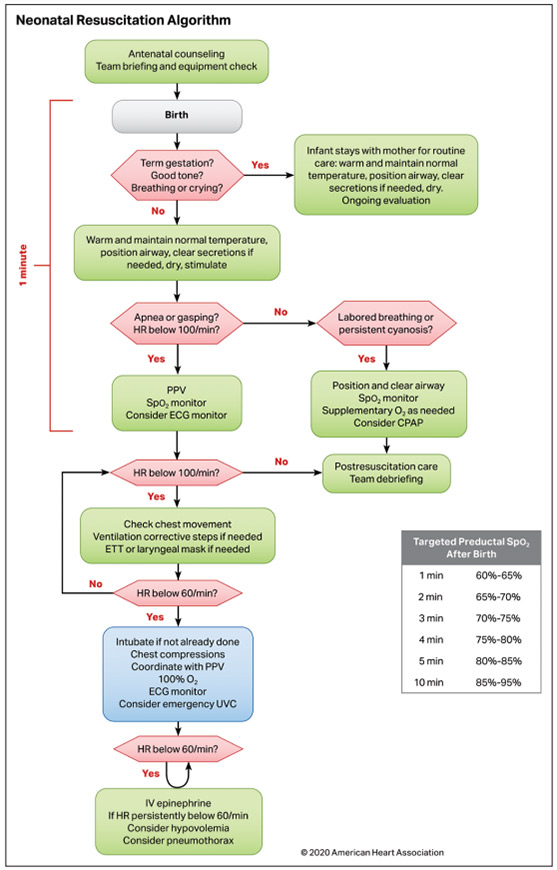
Algorithm adapted from the 2025 AHA/AAP Neonatal Resuscitation Guideline2025 AHA/AAP Neonatal Resuscitation Guideline · 2025 · CirculationCurrent US neonatal resuscitation guideline covering deferred cord clamping, thermoregulation, ventilation, chest compressions (3:1 ratio), epinephrine, and volume expansion for newborns.View source ↗.
Escalation Pathway
Neonatal resuscitation follows a stepwise escalation chain. Move to the next step only when the current intervention fails to raise the heart rate above 100 bpm AHA/AAP 20252025 AHA/AAP Neonatal Resuscitation Guideline · 2025 · CirculationCurrent US neonatal resuscitation guideline covering deferred cord clamping, thermoregulation, ventilation, chest compressions (3:1 ratio), epinephrine, and volume expansion for newborns.View source ↗.
- Warm, dry, stimulate, position airway — initial steps for all newborns who do not cry or breathe after birth PMID 411228872025 AHA/AAP Neonatal Resuscitation Guideline · 2025 · CirculationCurrent US neonatal resuscitation guideline covering deferred cord clamping, thermoregulation, ventilation, chest compressions (3:1 ratio), epinephrine, and volume expansion for newborns.View source ↗.
- Positive-pressure ventilation (PPV) — if HR < 100 bpm or ineffective breathing after initial steps. Use room air (21% O₂) initially in term infants; titrate oxygen to achieve preductal SpO₂ within target ranges PMID 411228872025 AHA/AAP Neonatal Resuscitation Guideline · 2025 · CirculationCurrent US neonatal resuscitation guideline covering deferred cord clamping, thermoregulation, ventilation, chest compressions (3:1 ratio), epinephrine, and volume expansion for newborns.View source ↗.
- Intubation or laryngeal mask — if PPV ineffective, chest not moving, or prolonged ventilation needed PMID 411228872025 AHA/AAP Neonatal Resuscitation Guideline · 2025 · CirculationCurrent US neonatal resuscitation guideline covering deferred cord clamping, thermoregulation, ventilation, chest compressions (3:1 ratio), epinephrine, and volume expansion for newborns.View source ↗.
- Chest compressions — if HR < 60 bpm despite adequate ventilation with 100% O₂ and endotracheal intubation. Use 3:1 compression:ventilation ratio (90 compressions and 30 ventilations per minute) PMID 411228872025 AHA/AAP Neonatal Resuscitation Guideline · 2025 · CirculationCurrent US neonatal resuscitation guideline covering deferred cord clamping, thermoregulation, ventilation, chest compressions (3:1 ratio), epinephrine, and volume expansion for newborns.View source ↗.
- Epinephrine — indicated only after adequate ventilation and at least 30 seconds of coordinated chest compressions fail to raise HR above 60 bpm PMID 411228872025 AHA/AAP Neonatal Resuscitation Guideline · 2025 · CirculationCurrent US neonatal resuscitation guideline covering deferred cord clamping, thermoregulation, ventilation, chest compressions (3:1 ratio), epinephrine, and volume expansion for newborns.View source ↗.
- Volume expansion — consider for suspected hypovolemia (pallor, weak pulses, poor perfusion, history of blood loss). Give 10 mL/kg normal saline IV/IO over 5 to 10 minutes; may repeat once PMID 411228872025 AHA/AAP Neonatal Resuscitation Guideline · 2025 · CirculationCurrent US neonatal resuscitation guideline covering deferred cord clamping, thermoregulation, ventilation, chest compressions (3:1 ratio), epinephrine, and volume expansion for newborns.View source ↗.
If resuscitation is not progressing despite the above steps, consider AHA/AAP 20252025 AHA/AAP Neonatal Resuscitation Guideline · 2025 · CirculationCurrent US neonatal resuscitation guideline covering deferred cord clamping, thermoregulation, ventilation, chest compressions (3:1 ratio), epinephrine, and volume expansion for newborns.View source ↗:
- Pneumothorax (transilluminate, needle decompression)
- Congenital airway anomaly (difficult intubation, failed ventilation) AHA/AAP 20252025 AHA/AAP Neonatal Resuscitation Guideline · 2025 · CirculationCurrent US neonatal resuscitation guideline covering deferred cord clamping, thermoregulation, ventilation, chest compressions (3:1 ratio), epinephrine, and volume expansion for newborns.View source ↗
- Congenital heart disease (cyanosis disproportionate to respiratory effort, poor perfusion despite volume)
- Severe anemia or hydrops (consider O-negative blood instead of saline for volume)
Code Medications
| Drug | Dose | Notes |
|---|---|---|
| Epinephrine IV or IO | 0.01 to 0.03 mg/kg (initial 0.02 mg/kg) PMID 33712718NRP Epinephrine Dosing (Kapadia) · 2021 · J PerinatolNRP recommends IV epinephrine 0.01-0.03 mg/kg and ETT 0.05-0.1 mg/kg; suggests practical initial doses of 0.02 mg/kg IV and 0.1 mg/kg ETT to reduce dosing errors.View source ↗ | Repeat every 3 to 5 min until HR > 60; give only after adequate ventilation and chest compressions |
| Epinephrine ETT | 0.05 to 0.1 mg/kg (initial 0.1 mg/kg) PMID 33712718NRP Epinephrine Dosing (Kapadia) · 2021 · J PerinatolNRP recommends IV epinephrine 0.01-0.03 mg/kg and ETT 0.05-0.1 mg/kg; suggests practical initial doses of 0.02 mg/kg IV and 0.1 mg/kg ETT to reduce dosing errors.View source ↗ | IV or IO route preferred when available; use ETT route only if no vascular access |
| Normal Saline | 10 mL/kg PMID 411228872025 AHA/AAP Neonatal Resuscitation Guideline · 2025 · CirculationCurrent US neonatal resuscitation guideline covering deferred cord clamping, thermoregulation, ventilation, chest compressions (3:1 ratio), epinephrine, and volume expansion for newborns.View source ↗ | For suspected hypovolemia; give over 5 to 10 min; may repeat once |
Endotracheal Equipment
| Gestation | ETT Size | ETT Insertion (cm) |
|---|---|---|
| 23 to 24w | 2.5 | 5.5 |
| 25 to 26w | 2.5 | 6.0 |
| 27 to 29w | 2.5 to 3.0 | 6.5 |
| 30 to 32w | 3.0 | 7.0 |
| 33 to 34w | 3.0 | 7.5 |
| 35 to 37w | 3.5 | 8.0 |
| 38 to 40w | 3.5 | 8.5 |
| 41 to 43w | 3.5 to 4.0 | 9.0 |
NRP 8th Edition sizing. Weight-based estimate: insertion depth (cm) ≈ 6 + weight (kg). PMID 411228872025 AHA/AAP Neonatal Resuscitation Guideline · 2025 · CirculationCurrent US neonatal resuscitation guideline covering deferred cord clamping, thermoregulation, ventilation, chest compressions (3:1 ratio), epinephrine, and volume expansion for newborns.View source ↗
Emergency Medications
| Drug | Dose | Notes |
|---|---|---|
| D10W | 1 to 2 mL/kg IV for glucose < 20 mg/dL or symptomatic hypoglycemia PMID 21357346AAP Neonatal Hypoglycemia Screening · 2011 · PediatricsAAP practical guide and algorithm for screening and management of neonatal hypoglycemia; recommends early identification of at-risk infants and prophylactic measures.View source ↗ | Recheck glucose q15 min; can use D10 ¼NS if > 1500 g |
| PGE₁ / Alprostadil | Initial 0.01 to 0.05 mcg/kg/min IV; titrate to effect PMID 40931686Alprostadil Dosing in Ductal-Dependent CHD · 2025 · Cardiol YoungSingle-centre retrospective study of alprostadil dosing in neonates with ductal-dependent CHD; higher doses associated with increased apnea, respiratory support, and fever.View source ↗ | For ductal-dependent congenital heart disease; monitor for apnea, hypotension, and fever (dose-dependent adverse effects) |